


How Timber Tokenization Disrupts Traditional Forestry Finance
The Asset Audit
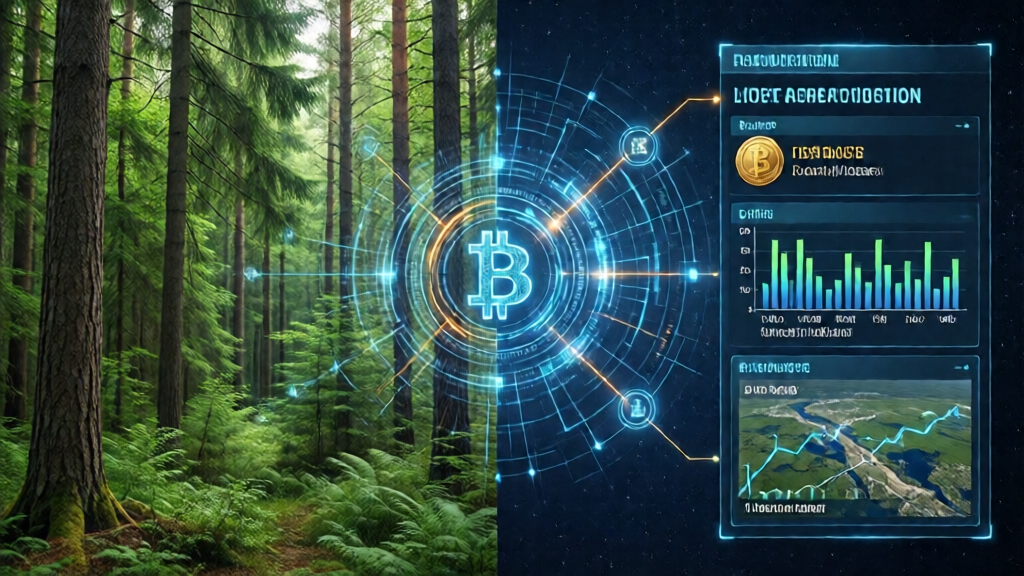
Timber tokenization operates through meticulously structured Special Purpose Vehicles (SPVs) registered under clear forestry law jurisdictions, often in Canada or Scandinavia, ensuring single-asset backing. Custody is delegated to independent third-party trusts mandated to hold physical standing timber and land rights. Verification layers include high-frequency satellite imaging and IoT sensor arrays embedded in parcels for real-time health and biometric growth tracking, integral for oracle accuracy.
The underlying asset is audited against harvestable volume (m³/year), age-class distribution, and biological growth curves. Data streams feed an on-chain oracle updated weekly, balancing operational costs with risk of valuation drift. Oracle verification frequency here is the critical failure point; lower frequencies risk lag-induced dislocation between token price and true timber yield.
Regulatory Landscape
By 2026, the maturation of MiCA 2.0 has defined tokenized forestry assets as regulated investment products within the EU, necessitating ERC-3643-compliant permissioned tokens for whitelist management and investor KYC. Hong Kong’s SFC has introduced stricter mandates on underlying asset custody and custody proof evidencing via blockchain attestations. Singapore’s MAS focuses on ensuring green premium transparency and carbon accounting integrity.
This regulatory triad landscape enforces a minimum verification cadence, custodial audit requirements, and prohibits token issuance without on-chain SPV formation to guarantee asset segregation and insolvency remoteness. Any project lacking these foundational pillars confronts investor flight risk once liquidity tightens.
Exit Liquidity Analysis
Large token holder sell-offs confront illiquidity at the physical level — timber harvest requires months of preparation, permits, and logistics. Transacting SPV shares or token units on-chain presupposes an off-chain counterpart buying harvest rights or future yield contracts.
A realistic exit liquidity model et=”_blank” href=”https://thewoodcoin.com/anti/”>anticipates 6–12 month realization windows with price discounts 5–15% below spot timber prices to reflect harvesting risk and market absorption capacity. Projects employing pre-arranged harvest forward contracts and flexible token redemption windows demonstrate comparatively lower exit friction.
The Math of Growth
We model net token yield (Y) as:
- G = Annual biological growth rate (m³增幅百分比)
- D = Timber density & quality factor (e.g., m³ to $/volume conversion)
- I = Token inflation/deflation rate (通缩效应)
- S = Market slippage and transaction cost
For example, if G = 4.5% (typical temperate softwood), D = $200/m³, I = 1.2% deflation via buybacks, and S = 0.5%, net yield approximates 7.3% annually, net of costs, aligning with conservative forestry investment norms.
Notably, this yield is decoupled from market hype cycles affecting speculative crypto assets, relying solely on the biological growth and forest management efficiency.
Comparison Matrix
Projectead> ead>
Asset Authenticity
Legal Jurisdiction & SPV Design
Liquidity Depth
Oracle Mechanism
TheWoodCoin
Third-party verified via remote sensing + on-site audits
Canada-based SPV with insolvency remoteness, ERC-3643 permissioning
Moderate; token buybacks + forward contracts support exit
IoT sensors + weekly satellite + Chainlink Oracles
ForestTokenX
Exclusive GPS tagging; manual annual audits
Offshore SPV in Cayman; limited on-chain permissions
Low; secondary market with no redemption rights
Monthly oracle updates; manual data aggregation
BioWoodChain
Satellite imaging only; no IoT integration
Singapore SPV; compliant with MAS green finance clauses
High; AMM liquidity pools with token burn model
Satellite only, weekly updates; no hybrid sensors
EcoTimberLedger
Manual forest ranger reports + local audits
EU SPV; ERC-20 standard, no advanced permissioning
Moderate; OTC market based
Biweekly oracle refresh; partial IoT deployment
e>
2026 Edge: ERC-3643 in Timber Tokenization
Implementing ERC-3643 allows timber token issuers to enforce whitelisting and KYC/AML dynamically on-chain, essential under MiCA 2.0 and jurisdictional mandates. Compared to traditional ERC-20 models, ERC-3643 reduces off-chain compliance overhead by encoding governance rules, enabling automated investor eligibility checks, and facilitating controlled secondary trading without compromising asset backing integrity.
This standard enhances trust and conforms to evolving RWA regulations, positioning timber tokens as credible alternatives in institutional portfolios seeking both transparency and regulatory alignment.


