


Turning Your Precious ‘Physical Memories’ into Liquid Tokens
In the evolving landscape of Real-World Assets (RWA), the transition from physical ownership to tokenized representations presents both opportunities and challenges. The core question remains: how do the tokens users hold correlate to actual physical assets like forestry rights, especially if the underlying blockchain protocol faces collapse?
The Asset Audit
For any RWA project, the legal structure is paramount. Typically, a Special Purpose Vehicle (SPV) is established to segregate the underlying physical asset from other liabilities. This entity acts as a custodian, holding the title to the physical asset—such as timberland—while issuing tokens that represent fractional ownership of this asset. To ensure the integrity and verification of these assets, technology such as satellite imaging and IoT devices provide real-time monitoring and validation of the land and its resources.
Regulatory Landscape
The regulatory framework for tokenizing assets varies significantly across jurisdictions. In the European Union, the MiCA 2.0 framework is expected to set a high standard for asset tokenization, necessitating clear rules on asset recognition and consumer protection. Meanwhile, regions in Southeast Asia and North America are also evolving their regulatory stances towards improved clarity in the RWA sector.
Exit Liquidity Analysis
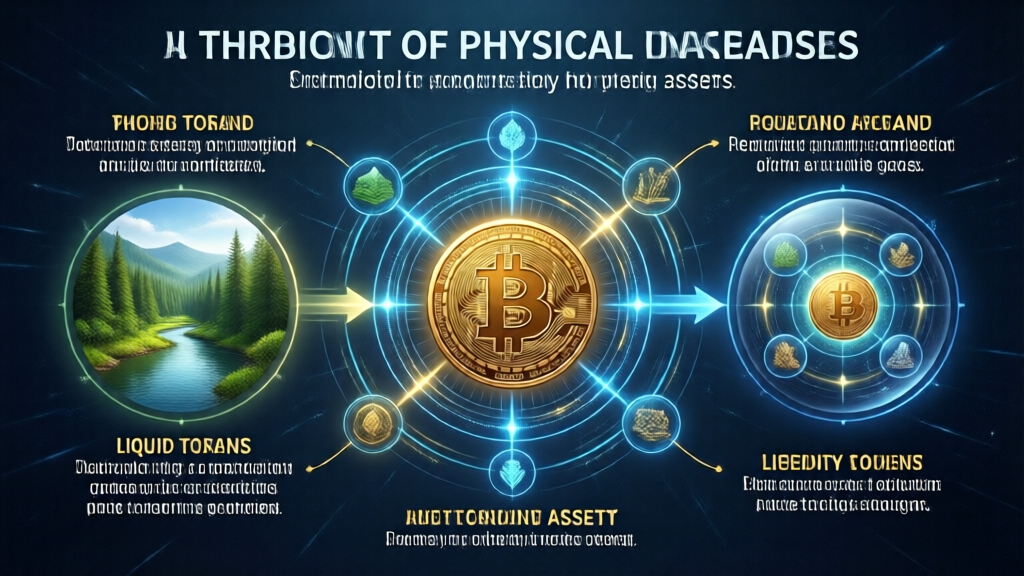
Evaluating the exit liquidity for tangible assets is essential. The transformation of physical memory into liquid tokens hinges on the immediate ability to sell or leverage these assets. The observation has been that forest products exhibit varied liquidity depending on market conditions, suggesting a need for robust exit strategies—particularly in scenarios of large-scale liquidation.
The Math of Growth
Calculating the yield potential of invested capital in timber involves understanding biological growth rates. For instance, if we consider an average annual growth rate of 4% for hardwood, and factor in a token deflation rate of 2%, the net yield could be estimated with the following formula:
Y = (G – D) * P
Where Y is the yearly yield, G is the growth rate (0.04), D is the deflation rate (0.02), and P is the principal investment. Therefore, the effective yearly yield equals 2% in this scenario.
Comparison Matrix
| Project | Asset Authenticity | Legal Jurisdiction | Liquidity Depth | Oracle Mechanism |
|---|---|---|---|---|
| Project A | Certified Ecosystem Standard | EU | High | Daily Oracle Updates |
| Project B | Blockchain Verification Audit | Southeast Asia | Medium | Weekly Oracle Updates |
| Project C | Third-party Certification | US | Low | Monthly Oracle Updates |
| Project D | Self-regulation | Global | High | Real-time Oracle Tracking |
2026 Edge
The integration of ERC-3643 standards allows for more nuanced permission management regarding asset ownership and trading. As we move towards 2026, these standards will play a significant role in promoting trust in RWA protocols, emphasizing transparent management and potentially lowering risks associated with asset volatility or misrepresentation.


